
Interview with Cataldo Valente
The works of the artist-artisan on display in Florence
by FRANCESCA JOPPOLO / Wall Street International Magazine ARTE
Peeking out the window onto the paintings of cherries and pears by Bartolomeo Bimbi hanging in the Accademia dei Georgofili, going to Santa Croce two or three times a day. These are the childhood playthings of Cataldo Valente in Florence.
“Imagine, from my house you could see into the first section of the Vasari Corridor, and glimpse some of Domenichino and “The Card Players” by Bartolomeo Manfredi.”
1950s. Little Cataldo had plenty of time on his hands and enjoyed art. Born in Puglia, at two-and-a-half years old he arrived in Florence into something out of Visconti’s “Rocco and his Brothers”, a few metres from Palazzo Vecchio, unaware that its beauty would influence his destiny. He also attended boarding school in Settignano in a splendid villa that had once belonged to Aldo Palazzeschi’s parents.
He defines himself as an artist-artisan and his exhibition goes on until December 31st at the Museum of Anthropology and Ethnology in Florence, where he has worked since 2008. A place, wrote the first Director, Felice Fontana, in the 18th century, whose collections were not only intended to satisfy the “people’s curiosity, but must be educational and for public use”. With exhibits that “speak for themselves” so everyone could “understand them without a teacher”.
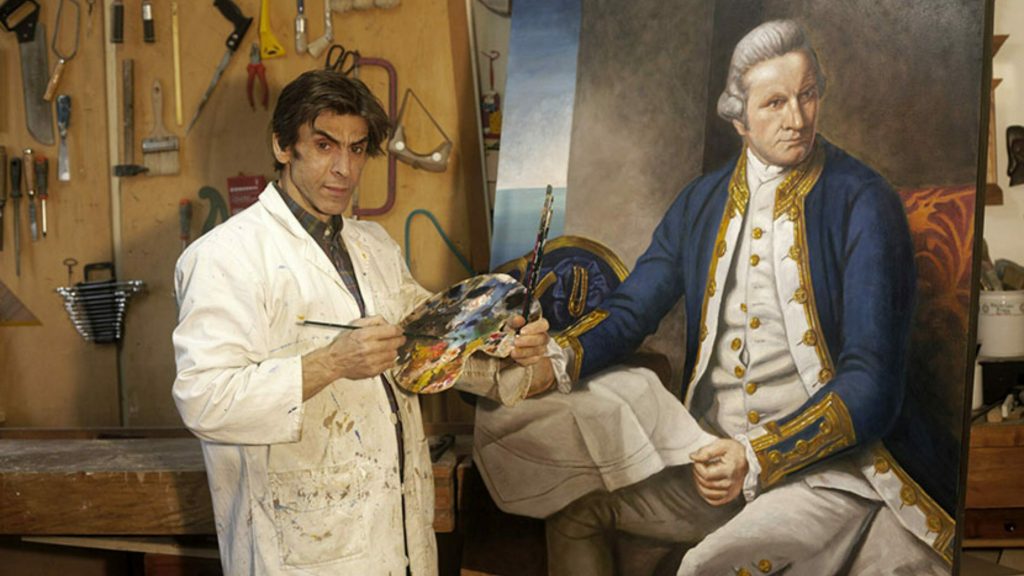
Amid the cultures and objects of the museum’s collections, Cataldo Valente was inspired to create the 24 works in pastel for “Portraits of the Whole World”, the faces of men and women that represent an ode to diversity. In addition, “Museums in the Museum” are 12 mixed-media works depicting different rooms in imaginary art gallery.
You grew up right at the center of art.
In that melting pot between the Ponte Vecchio, Piazza della Signoria and the Uffizi. In Via dei Georgofili to be precise, where the bomb exploded in 1993, though I had already moved away by then. But I knew the family who were killed in the explosion. Remember that in my time entrance to the Uffizi was free for Florentines. So on Sunday mornings I often walked up the grand staircase. And also – well, eh, there weren’t all these tourists like there are now – in the 60s-70s no one was there. Like at the Bargello now. The Director of the gallery, Luciano Berti, was the one who discovered Masaccio’s polyptych of San Giovenale. I also remember seeing Antonio Paolucci on his bicycle when he was young, who used the back entrance in Via della Ninna.
What works impressed you the most?
As a child, all of them. You entered, you were awestruck by the majesty of Giotto, Cimabue and Duccio. You were tiny next to these four-metre-tall Madonnas, with all that gold. The staging was wonderful, curated by Michelucci and Scarpa. Giotto’s fake marble impressed me because it looked like abstract paintings. And also Piero della Francesca. In “The Battle of San Romano” by Paolo Uccello you enter a dream world, from the imagination of the Middle Ages: the duels, the perspective of the spears, the horse with its legs almost in reverse. Another painting that I loved was the “Thebaid”, now attributed to Beato Angelico but back then it was attributed to Gherardo Starnina. Starnina wasn’t the best, but he was still quite good. I spent hours and hours looking at those tiny oared ships. I didn’t understand the term Thebaid (laughs), but later I learned it was an area of Egypt where Christians took refuge. It is an immense narrative painting recounting many stories, with the winds billowing the sails, the wolf in the mountains, the bear.
With whom did you go to the Uffizi?
In the beginning I went with my older brother Giuseppe who was a cabinetmaker. In fact, I learned marquetry from him and my father. They were great woodworkers, in Via dell’Anguillara. They used to make the famous Maggiolini furniture which now goes to auction for millions. I helped with the inlay in maple, which is a very light wood: the drawing had to be done in chiaroscuro, with hatching.
Set Designer at the Museum of Anthropology and Ethnology and artist-artisan. You seem to be a special figure.
Quite atypical. Right now I’m redesigning the Borneo gallery. I designed the project, although some of the larger pieces are constructed externally by a carpenter under my supervision, I build the sets myself that display the objects. I went to art school, l’Accademia dell’Arte, then I enrolled in architecture. But I also studied at Vittorio Gassman’s theatre workshop, with Eduardo De Filippo. I have a letter from Eduardo. Actually a poem.
FOR YOU?
For me. To Cataldo.
TELL ME MORE.
1980, the Director of the Pergola Theatre was Spadoni, the Culture Councillor was Camarlinghi. They called it a workshop to indicate that acting is a craft. That was important to Gassman. At the time, I worked both with my family and with the old woodcarver Gino Doni, who was also on Via dell’Anguillara and had restored the choir stalls of the Abbey of Montecassino after the bombing. I believe he came from the Coppedè workshop, representing the line of Florentine tradition which, as you know, takes you to Donatello, to Arnolfo di Cambio. It was all over by the 90s. If you wanted to learn artistic craftsmanship you still could. Now what can you do? Returning to the theatre: we did a two-month internship with Eduardo, who came almost every day despite the fact that, poor thing, he had undergone eye surgery and was wearing glasses with a bandage. It looked like another one of his masks. He was accompanied by a woman, I don’t know if it was the Marina Confalone. In small groups we had to write a play “The Goldsmith’s Workshop”, a story he chose, and he gave us advice. There should be a robbery, he explained, of the diamond cutters of Amsterdam, in short an event or a character that would create interest for the audience. Eduardo, such a talent. You can’t explain it, you just know. You know, and you can say it having met him. He passed things on to us… It seems almost impossible that a person like him would have been there with us. He made it look easy. In short, I remember his lesson from that last day, because I was impressed by Monica Vitti reciting a poem in a documentary about Eduardo on television. “Love is something that smells like a rose but it is not a rose. Guess what it is?” he wrote to me. I have it here, like a relic. To the other students he had written the classics: with affection, with sympathy.
Tell us about your exhibition that is divided into two sections.
“Portraits of the Whole World” I care about most because it is linked to my life at the Museum of Anthropology and Ethnology. Since working here, every time I set up a new exhibit or rearrange objects from a particular culture, when I handle a comb, a hat, I need to think as the local people do and imagine who used it, who wore it. One of the first galleries on the ground floor that I refurbished was India, so I was looking at images of Indian women, Indian children, a handsome mustachioed gentleman in a turban, and when I found the right one I really enjoyed drawing it, in an immediate way, very quickly. I usually drew these on the way home, on the tram. All it takes is a sketchbook, two Giotto pencils. It’s something of mine that I can to add to the staging of a lacquer, an ivory, a kama sutra. Then I redesigned the galleries for Africa, North America. This museum is founded precisely on the diversity of all the peoples who are brought together here, and so I have hung the drawings on the wall in an oval, because the world is not exactly round, but a bit flattened at the poles, and because graphically it’s less banal, with different frames for each portrait. It was like shuffling cards. In today’s culture, you find Indians, South Americans, and Chinese people living side-by-side in cities.
Is this how you show your love for humanity?
Yes, it’s a universal embrace. During the pandemic, I had so much time. I also did one drawing a day. The other part of the exhibition, “Museums in the Museum”, is linked to my passion for art history which, as I said before, began as a child, living between the Ponte Vecchio, the Uffizi and Palazzo Vecchio, and continues to this day. For example, I recently read a book about how the columns of Santo Spirito and San Lorenzo were made. Sculpting a column for San Lorenzo, making it just perfect. The capital. Then they carried them to the church with cows.
But there’s also a lot of humor in The Museum that Lives Within Me.
Yes, so as not to take yourself too seriously. In one of the pieces, dedicated to the Cubist geniuses Braque and Picasso, I placed a Cubist on a cube.